


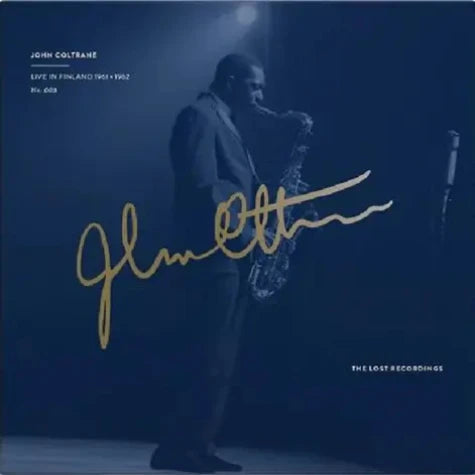
Live In Finland 1961 & 1962
Free Delivery Over £150 | 30-Day Returns
Couldn't load pickup availability
Pickup available from our .
Usually ready in 1 hour
Description
John Coltrane was never a loner. A tireless worker, he was on a perpetual quest to learn from others and build symbiotic relationships with them. Before playing, he listened. The 1950s were dazzling years, and decisive ones; he performed with Ellingtonian Johnny Hodges, collaborated with Dizzy Gillespie's band, and met Charlie Parker and Bud Powell. Then he encountered Miles Davis.
Coltrane pursued his quest. In the space of just a few months he met Thelonious Monk, Yusef Lateef, Sonny Rollins, McCoy Tyner, Elvin Jones and Eric Dolphy. All of them shared the same passion for musical creativity. They were all exploring new modes of expression and new sounds, seeking a dense playing style that could cascade across astonishingly rapid tempi. To the standard harmonic chart, they added cycles of thirds that made polytonality a realm of infinite possibilities.
On November 22, 1961, at the Kulttuuritalo in Helsinki, John Coltrane, Eric Dolphy, McCoy Tyner, Reggie Workman (on bass) and Elvin Jones were on stage. "My Favorite Things," which opened the session, is from Rodgers & Hammerstein's musical comedy The Sound of Music. Coltrane had made the piece one of the iconic hits of his career, and in March of that year had released an eponymous album.
One detects in this piece the extension of innovations found in Kind of Blue: long modal passages alternate between major and minor modes. Coltrane said of it, "This waltz is fantastic: when you play it slowly, it has a ‘gospel' aspect, which is not at all unpleasant; when you play it fast, it has certain other undeniable qualities. It's very interesting to discover a terrain that renews itself according to the impulse that you give it; that's the reason why we don't always play this tune in the same tempo." Nothing is ever fixed with Coltrane, and this version is no doubt one of his finest...
It has often been said that everything Trane did, he did to excess — drugs and alcohol, then cigars, vegetarianism, and finally, religion. Overlooked, though, was his obsession with friendship, his passion for group musical performances where — owing to his high expectations of himself and others — the contribution of each individual musician was elevated. Even his spiritual conversion late in life was not self-centered. Miles Davis wrote in his autobiography that Coltrane turned into a diamond. He could have added that Trane was considered a beacon; he shaped music in general and jazz in particular, and he guided entire generations of immense jazzmen.
Delivery & Returns
Free Delivery on all orders over £150.
On orders below £150, the following delivery costs apply:
- Royal Mail Tracked 24® | £6.50 | 1 to 2 business days
- Royal Mail Tracked 48® | £5.50 | 2 to 3 business days
Returns
We also offer a generous 30-day returns policy in case you change your mind.
Live In Finland 1961 & 1962
If you have any questions, you are always welcome to contact us. We'll get back to you as soon as possible, within 24 hours on weekdays.
-
Shipping Information
Use this text to answer questions in as much detail as possible for your customers.
-
Customer Support
Use this text to answer questions in as much detail as possible for your customers.
-
FAQ’s
Use this text to answer questions in as much detail as possible for your customers.
-
Contact Us
Use this text to answer questions in as much detail as possible for your customers.
More from The Lost Recordings

More popular Classic Jazz records

Used on 22 products (from first 50)